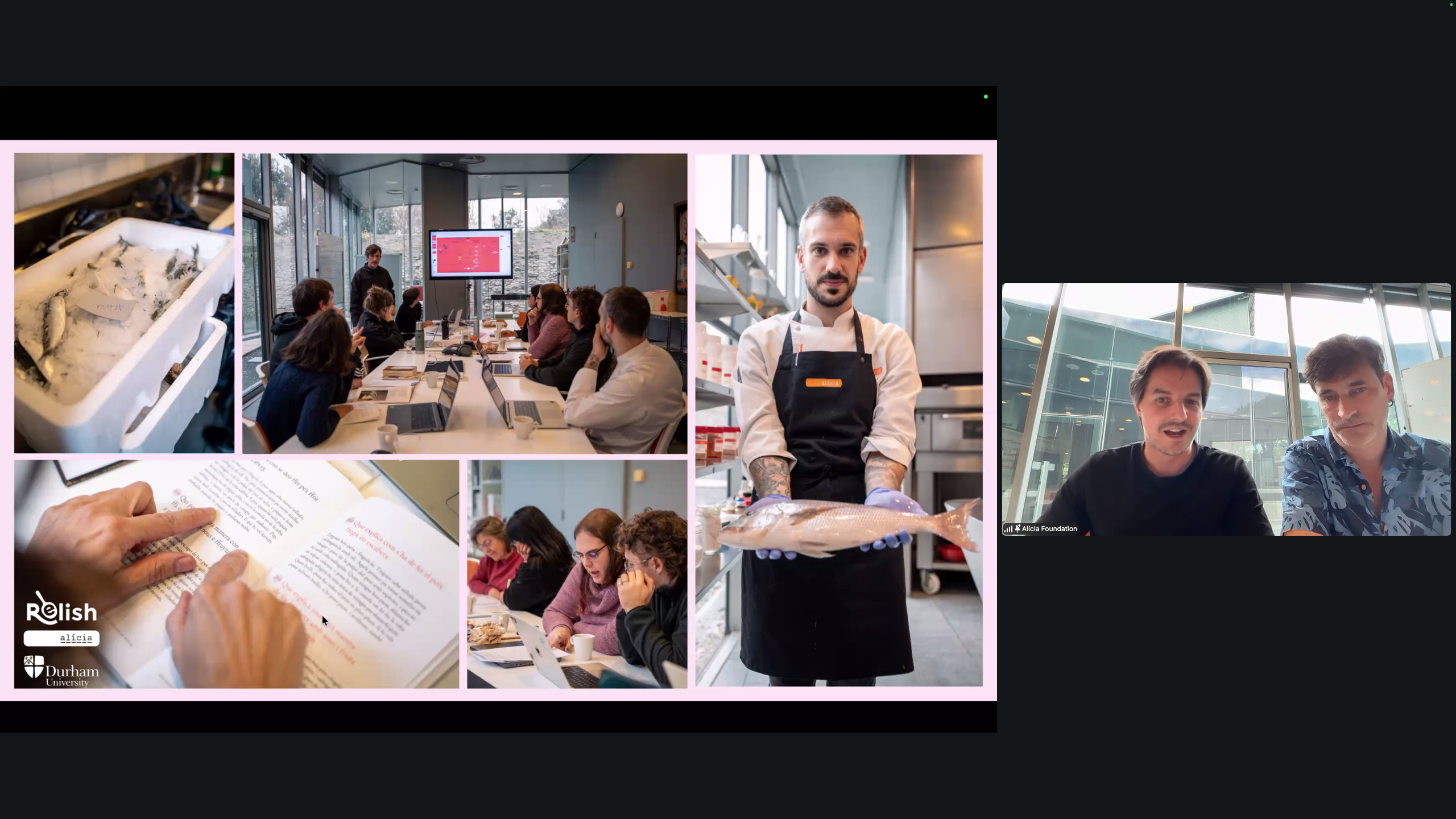
On April 30, 2026, RELISH partners presented their current work on historical recipe methodologies and interpretation at a webinar hosted by the International Society for Gastronomic Sciences and Studies (ISGSS).
The ISGSS is a global community dedicated to conducting research and studies in the field of sustainable gastronomy, melding local wisdom with academic expertise to advance food sovereignty and justice.
Moderated by Professor H. Rosi Song (RELISH Lead, Durham University), the panelists included Dr. Joan Ribas Serra and Chef Vinicius Martini-Capovilla from Fundació Alícia, and Dr. Janita Van Dyk from Durham University. In the webinar, “Living Recipes: Negotiating Culinary Heritage through Historical Recipes,” panelists discussed the design, development, and goals for recreating and interpreting historical recipes for research and culinary application.

You can read the full abstract of the RELISH webinar below. If you are a member of the ISGSS, you can access the webinar recording on the ISGSS member portal.
Many thanks to ISGSS for hosting us for their first webinar of 2026, and all the audience members for their engaged questions and feedback.
Keep an eye out for future avenues to learn more and participate with Living Recipes!
Full abstract
“This webinar provides a look into a recipe workshop organised for the HE Project RELISH (Project 101177427) – Reframing European Gastronomy Legacy through Innovation, Sustainability and Heritage that took place at Fundació Alícia in Barcelona, Spain in December of 2025. In the webinar the organisers of the workshop and the methodology to recreate a 14th century dish – escabetx – and its evolution in Catalan gastronomy discuss what goes into reconstructing a dish from a historical or geographically distant recipe and the complex interpretive process that it entails. A recipe cannot be understood merely as a list of ingredients and procedural steps (actions); rather, it functions as a cultural artefact, embedded within a specific historical, cultural, social, technological, linguistic, and sensory context (Montanari, 2006). As such, it encodes tacit knowledge, shared assumptions, and material conditions eligible to its original audience but often constituting lost information for audiences removed from that historical context (Scully, 1995).
The webinar highlights how recipes originating in different historical periods or cultural contexts pose distinct interpretive challenges. Recipes from geographically distant contexts, for example, may function as complete and coherent instructions within their own culinary systems, yet become prone to misinterpretation when read outside those systems. In both cases, interpretive difficulties arise not from a lack of information per se, but from the absence of shared cultural, technical, and sensory reference points. Consequently, such recipes may appear fragmentary or ambiguous to present-day readers, with quantities omitted, techniques implied rather than described, and sensory objectives assumed rather than explicitly stated. Addressing this gap therefore necessitates a structured approach that combines historical and geographical research, contextual and cultural analysis, culinary expertise, and iterative experimentation. The webinar will share materials prepared for the workshop, video and images that resulted from the tracing of the dish from the 14th century to the early 20th century in Catalonia, Spain.
This webinar offers opportunities for panelists and participants to explore how recipes originating in different historical periods or cultural contexts pose distinct interpretive challenges. Together, panelists will introduce their current work developing new methods and approaches to working with recipes as cultural artefacts.”